
Assisted Living in Wisconsin: A Family Guide
What assisted living is called in Wisconsin, what it costs, how Medicaid can help, how to check a community’s license and inspections, and who to call if something goes wrong. Every fact links to the official source.
- Licensed by
- Wisconsin Department of Health Services (DHS), Division of Quality Assurance (DQA), Bureau of Assisted Living1
- Licensed communities on Lilisity
- 1,845 assisted living, 2 with memory care
- Medicaid help
- Yes: Family Care2
- Typical cost
- $6,540 a month (state median, CareScout 2025)
- Long-term care ombudsman
- 1-800-815-00153
- File a complaint
- 800-642-65524
What assisted living is called in Wisconsin
- Community-Based Residential Facility (CBRF)A licensed home for five or more unrelated adults who get care beyond room and board, including up to three hours of nursing care per week each.5
- Residential Care Apartment Complex (RCAC)Apartments in an independent apartment complex where five or more adults live, with no more than 28 hours a week of services like nursing, personal help, and emergency help. Certified RCACs can take Medicaid; registered RCACs are private-pay only.6
- Adult Family Home (AFH)A small home where adults live with care beyond room and board. DQA licenses 3-4 bed homes; counties oversee 1-2 bed homes.7
What assisted living costs in Wisconsin
The median cost of assisted living in Wisconsin is $6,540 a month, above the national median of $6,200 (CareScout Cost of Care Survey 2025, collected July to November 2025). Prices vary with the apartment, the level of care and the community, so ask each one for its current rate sheet, including care-level fees.
If more care is needed later: nursing home costs in Wisconsin, with CareScout medians and the private-pay rates Wisconsin nursing homes publish.
Plan with our free tools: how long will the money last? and home care or assisted living?
Paying for assisted living in Wisconsin
Medicare does not pay for assisted living. Families pay from savings and income, long-term care insurance, or benefits such as VA Aid and Attendance (estimate it). Who actually pays for long-term care.
Medicaid. Family Care offers a full range of long-term care services through managed care organizations (MCOs), and your MCO care team must approve services first. Its benefits include residential services in settings like adult family homes and residential care apartment complexes. Program: Family Care.2 Medicaid does not pay rent or meals in assisted living in any state, and not every community accepts it, so ask each one.
How to check a community in Wisconsin
Look up a license. Search DQA's Provider Search by location or facility type (CBRF, RCAC, adult family home). The search page says it is moving to a new DHS tool called Wisconsin Provider Finder. Search Wisconsin’s records.8
Inspection reports. Pick a facility in Provider Search. Many providers have a Survey History section, which shows DQA surveys from the last three years. Posting may be delayed; if you can't find one, email dhswebmaildqa@dhs.wisconsin.gov.9
Lilisity shows Wisconsin’s inspection record on each community’s page where the state publishes one: the state’s own records, dated and linked to the official source.
Always visit in person, at a mealtime or in the evening if you can. Bring the tour scorecard and the 8 tour questions.
If something goes wrong
Complaints about care or conditions. DQA takes complaints about licensed providers, including CBRFs, RCACs and 3-4 bed adult family homes. File online (form F-00607), call the toll-free line, or contact a Bureau of Assisted Living regional office. Call 800-642-6552 or file online.4
Abuse, neglect or exploitation. How to report.10 If someone is in danger, call 911.
The long-term care ombudsman is a free advocate for residents of assisted living and nursing homes: they help resolve problems with a community, including move-out notices. Call 1-800-815-0015 or find your local ombudsman.3
Find assisted living in Wisconsin
Assisted living by city
Every community and county in Wisconsin · 1 with verified resident testimonials
Common questions
Family Care offers a full range of long-term care services through managed care organizations (MCOs), and your MCO care team must approve services first. Its benefits include residential services in settings like adult family homes and residential care apartment complexes. Medicaid does not pay rent or meals in assisted living.
The median is $6,540 a month (CareScout Cost of Care Survey 2025), compared with $6,200 nationally.
Wisconsin Department of Health Services (DHS), Division of Quality Assurance (DQA), Bureau of Assisted Living.
DQA takes complaints about licensed providers, including CBRFs, RCACs and 3-4 bed adult family homes. File online (form F-00607), call the toll-free line, or contact a Bureau of Assisted Living regional office. Phone: 800-642-6552.
Search DQA's Provider Search by location or facility type (CBRF, RCAC, adult family home). The search page says it is moving to a new DHS tool called Wisconsin Provider Finder.
Sources
- Licensing agency (dhs.wisconsin.gov)
- Medicaid (dhs.wisconsin.gov)
- Ombudsman (boaltc.wi.gov)
- Complaints (dhs.wisconsin.gov)
- License types (dhs.wisconsin.gov)
- License types (dhs.wisconsin.gov)
- License types (dhs.wisconsin.gov)
- License lookup (forwardhealth.wi.gov)
- Inspection reports (dhs.wisconsin.gov)
- Reporting abuse (dhs.wisconsin.gov)
- CareScout Cost of Care Survey 2025 (state medians)
Facts checked against these official sources on September 28, 2026. Rules and programs change; confirm with the agency before making a decision. General information, not legal or financial advice.
What will senior living cost, and how will we pay?
Our free guide shows the starting prices communities post for each kind of care, walks you through a monthly budget, and explains how insurance, VA benefits, Medicaid and Medicare can help.
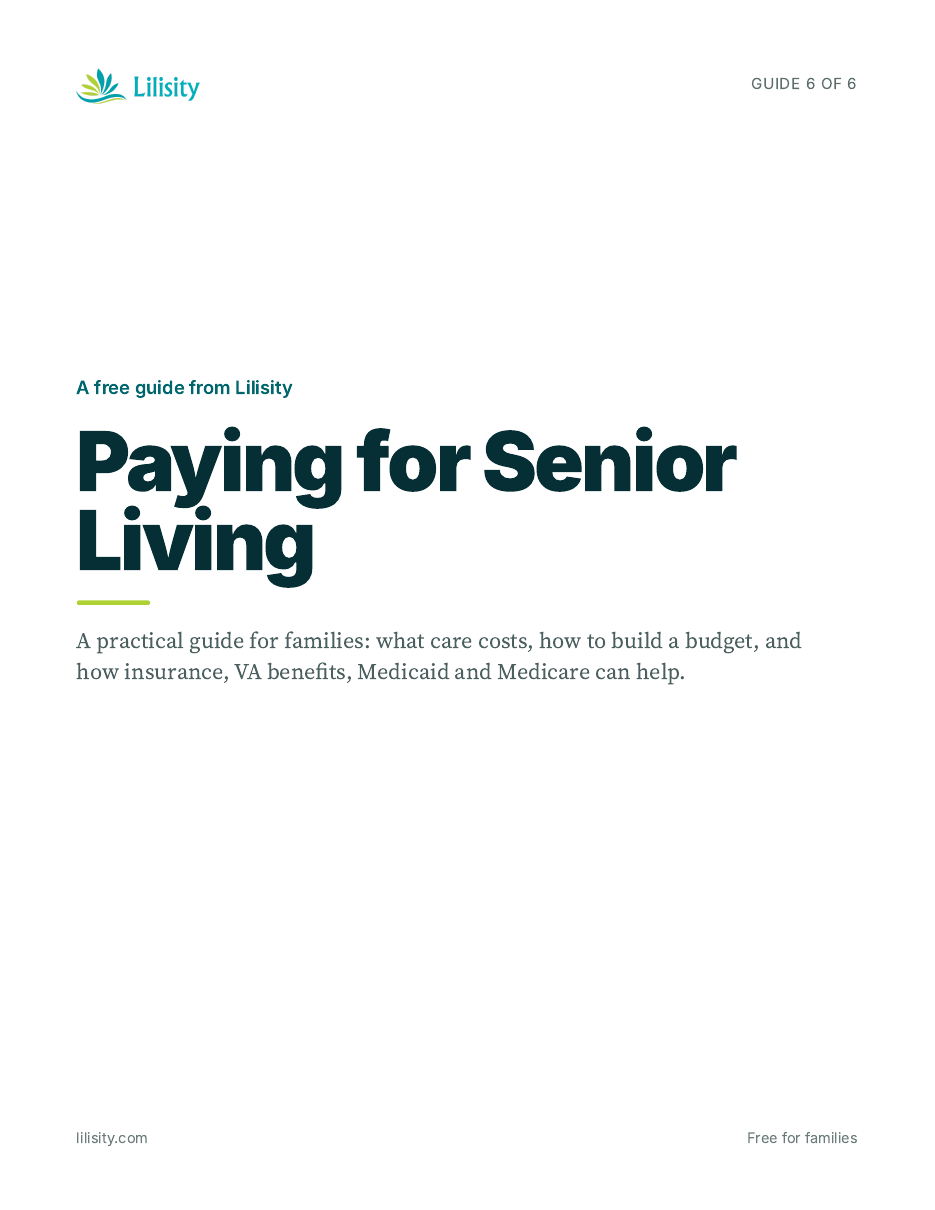
Free guide · 16 pages
Paying for Senior Living
Costs by type of care, a monthly budget, and how insurance, the VA, Medicaid and Medicare help.